
Bow Wharf at risk again – make your voice heard by November 14 deadline
Summary
H20 Urban has resubmitted plans for 66 homes at Bow Wharf, largely unchanged from the scheme refused in December 2025 – the main change is 13 social rent homes instead of 3.
The proposals include one small commercial unit, new access from Wennington Rd. and associated public realm works.
The Forum believes it still falls short on affordable housing, employment space and heritage.
No updated financial viability statement from September 2025 has been included in the application documents.
Comment by 14 November quoting PA/26/01692/A1.
Image below shows proposed redevelopment from the north east. All upper floor flats facing the canal would have suspended balconies.
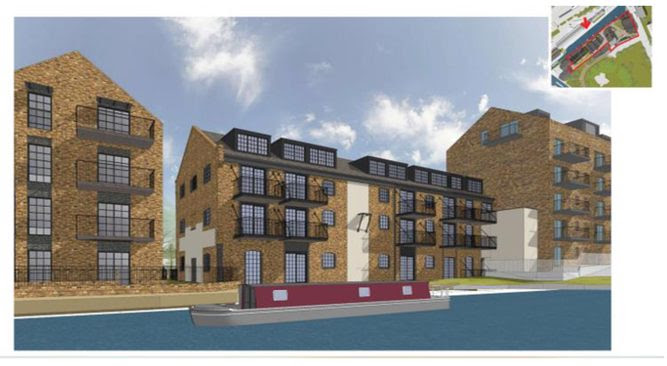
The H20 Urban partnership between Canal & River Trust, owners of Bow Wharf, and Bloc Ltd, a property developer, have submitted a revised planning application (No. PA/26/01692/A1) for the redevelopment of the site. It’s similar to the one rejected by Tower Hamlets Council in December 2025.
It includes:
- The demolition of the timber pavilion buildings currently providing needed employment space
- The conversion of the locally listed former warehouse, currently Regent’s Lake banqueting venue, to residential flats
- The erection of two new residential blocks, one on the site of the timber pavilions, and one along Grove Road
- Demolition of the Canal & River Trust office adjacent to the Mexican Seoul restaurant to provide a new access to the site on Wennington Road.
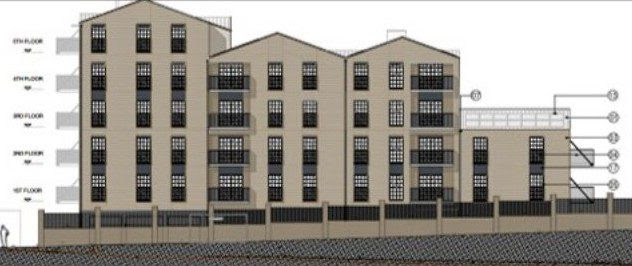
Drawing below is proposed Block D as seen from Grove Rd
Reasons for the previous planning refusal in December 2025:
- Insufficient justification was provided for the loss of employment floorspace (Part 2 of Policy D.EMP3).
- The proposal failed to provide the maximum viable amount of affordable housing contrary to policy H4 of the London Plan (2021) and policies S.H1 and D.H2 of the Tower Hamlets Local Plan (2020).
- The proposal failed to provide an acceptable affordable housing tenure mix, with an overprovision of intermediate units and under provision of low cost rent units; contrary to policy H6 of the London Plan (2021) and policies S.H1 and D.H2 of the Tower Hamlets Local Plan (2020).
H20 Urban’s financial viability statement showed a forecast deficit on the project of £1.3 million, but a review by the Council showed a surplus of just over £3 million.
What has changed?
H20 Urban have simply increased the amount of affordable housing from 15% to 20%.
The updated proposals give an increase of around 10 homes, to a total of 13 at social rent, and a reduction of 7 to 0 homes at intermediate rent. There is no change in the total number of 66 homes.
Some concerns over the proposals
Changes in character and use: The site has historic significance as part of the Regent’s Canal Conservation Area (Link), and includes two locally listed buildings that would be affected by the proposals. The surrounding area also contains several Grade II listed buildings and structures, including the listed bridge immediately to the west of the site.
The character of Bow Wharf would be irreversibly changed from a local heritage site for leisure and employment, with 34 homes added in 2018, to a predominantly private housing development. The banqueting venue would be lost as a community space, and the Mexican Seoul restaurant could well leave due to the disruption of a 2 year construction period. The loss of the car park will also impact the gym, bar, and other businesses.
Insufficient affordable housing: The Forum considers the land is publicly owned, and that the Canal & River Trust (CRT) is a public body / public sector institution for planning purposes. This is evidenced by formal regulatory decisions, statutory context, and planning practice.
Public land is defined as: ‘Land that is owned or in use by a public sector organisation, or company or organisation in public ownership or land that has been released from public ownership and on which housing development is proposed.’ — ‘Threshold approach to Affordable Housing on Public Land’, GLA Practice Note.para.9, July 2018. (Link). GLA Practice Note.para.9, July 2018.
The London Plan (2021) H4 (Link) – Delivering Affordable Housing, includes the specific measure: ‘public sector land delivering at least 50 per cent affordable housing on each site.’
Tower Hamlets general housing policy S.H1 sets an ‘overall target for 50% of all new homes to be affordable’. It explains: ‘Applicants are strongly encouraged to meet or exceed the delivery of 35% affordable housing. Lower levels will only be accepted where robustly justified through viability evidence and where it is demonstrated that there are clear barriers to delivery.’
Insufficient justification of the loss of employment space: The Employment Land Commercial Market Assessment states ‘that the continued refurbishment and retention of the existing employment accommodation does not represent the most sustainable long-term use of the site.’
Tower Hamlets Policy D.EMP3 requires either ‘evidence of active marketing over a continuous period of at least 24 month…’ or to ‘provide robust demonstration that the site is genuinely unsuitable for continued employment use due to its condition; reasonable options for restoring the site to employment use are unviable; and that the benefits of alternative use would outweigh the benefits of employment use.’
The Regent’s Lake banqueting venue has been allowed to run down, but the report acknowledges it ‘has accommodated leisure-related uses and…. the building’s character, open internal spaces and canal-side setting lend themselves to certain leisure uses.’ The report asserts without evidence, that ‘the long-term market for such uses has become increasingly limited.’ The popularity of other canalside locations across London does not support this opinion.
The following section of the report states ‘the timber pavilion buildings remains substantially occupied, reflecting the continued demand for smaller, lower-cost business premises within East London.’ The specific location is important to a considerable number of occupiers, such as a local architectural practice, a Pilates service and office for a local church. The view that ‘we consider there to be realistic opportunities for existing occupiers to relocate without materially affecting the continuation of their businesses’, is not based on a knowledge of the businesses concerned, and underestimates the challenges they would face.
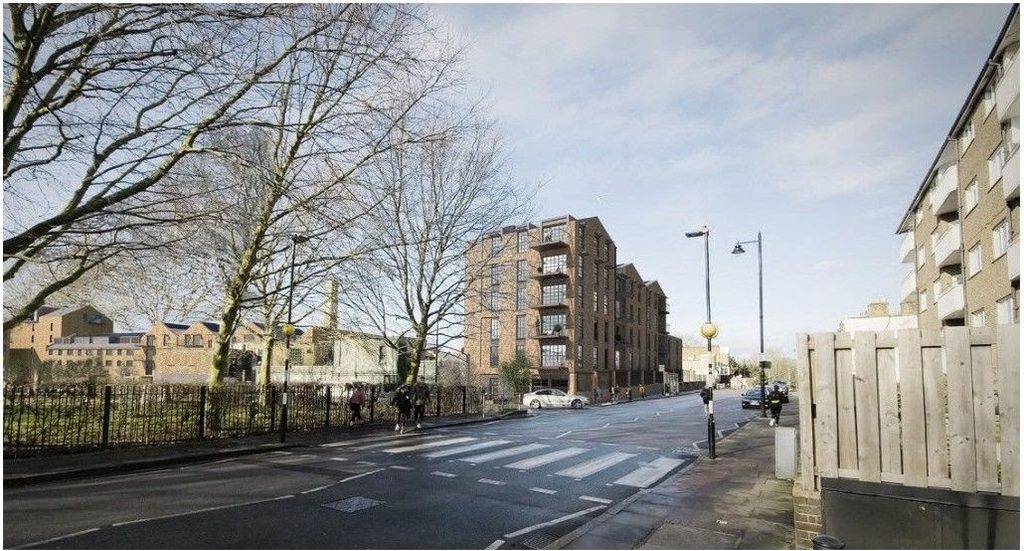
The image below is the Trust’s projection of what block D would look like from Grove Road towards Victoria Park – 6 floors next to Wennington Green, tapering to 3 at the canal.
Contrary to the Roman Road Bow Neighbourhood Plan policy for Bow Wharf
The Canal & River Trust consistently refused to share a 2019 ‘heritage appraisal’ on Bow Wharf commissioned by H20 Urban, the private partnership the Trust formed with property developer, bloc. The Trust claimed the report was held by this private partnership, and exempt from the Environmental Information Regulations (EIR).
A complaint by the Forum led to the Information Commissioner eventually issuing a Decision Notice in October 2025. This found the Trust, as a ‘public authority’ did hold the requested information for the purposes of the EIR. The Commissioner’s position (para. 20) was that the report ‘confirms that the area falls within the Regent’s Canal conservation area, and lays out a number of heritage assets which may be affected by the proposed development.’
The Trust then appealed against the decision notice, and the case was due to be heard on 1st July 2025 by a Tribunal. The day before the hearing the Trust’s solicitors informed the Tribunal they were withdrawing their appeal – no reasons have been provided, despite a request for an explanation.
The Canal & River Trust then made a fresh response to the Information Commissioner’s Decision Notice, sending the Forum a copy of the detailed 2019 heritage appraisal. This is now part of the present planning application.
The adopted neighbourhood plan (pages 59-61) contains the specific policy for Bow Wharf below. The proposals fly in the face of the policy.
The Canal and River Trust sent out a letter through Your Shout to local residents and businesses in August. This gave an outline of the proposals and a link to a website. Only 3 weeks were allowed for responses, and there were no in-person or online Q & A sessions to engage with the Trust and architects.
Policy HE1: Bow Wharf waterway infrastructure conservation and enhancement.
- Development proposals at Bow Wharf must demonstrate how they reflect the historic character of the area and how they will enhance both its heritage significance and cultural vibrancy.
- Proposed development must therefore submit a comprehensive statement of historic significance clearly demonstrating how proposals positively reflect and are informed by the existing historic context and how the proposals will enhance the historic character of the area.
- Developers are advised to ensure plans are developed in consultation with the Council’s conservation team, Neighbourhood Forum and the Canal and River Trust. Proposals must demonstrate widespread consultation with local businesses, residents and community groups.
- Development proposals must provide for an appropriate mix of uses that include leisure and recreational activities and, where workspaces are provided as part of redevelopment, affordable workspaces for small businesses should be provided in line with the Local Plan. Recreational provision that improves connectivity with the Green Grid and better links Victoria and Mile End Parks and/or Hackney Village with the Roman Road, will be strongly supported.’
How to comment on the planning application
Include planning application number, PA/26/01692/A1 for Bow Wharf.
You can comment by 14th November on the Tower Hamlets website, email development.control@towerhamlets.gov.uk, or write to:
Planning
Housing and Regeneration
Tower Hamlets Town Hall
160 Whitechapel Road
London
E1 1BJ
Summary of recent Bow Wharf planning history
2002: Planning application for development refused, both initially, and on appeal.
2011: Application for 34 housing units initially refused, but allowed on appeal.
2025: Application (PA/25/00557/A1) for 66 housing units and 1 commercial unit. Refused in December 2025.
The Tower Hamlets officer’s report on the 2025 application gave the main reasons for refusal:
‘The proposal fails to provide the maximum viable amount of affordable housing and would provide only 3 low cost rented homes, which equates to 30% of the overall affordable housing offer- far below the policy target of 70% which is set to meet the evidenced need for low cost rented homes for the boroughs residents.’
Regarding the National Planning Policy Framework (NPPF), the report said:
‘Substantial weight is given to the value of the use of this brownfield land for the provision of new homes. But significant weight is also given to the need to support economic growth and productivity and the proposal would not protect the employment land on the site.’
The report concluded:
‘For the reasons outlined above, substantial harm would be caused by this development.’
The neighbourhood plan Bow Wharf policy is listed in the report as a key planning policy, but not mentioned further. Little consideration overall was given to the heritage value of the site and its use for leisure and recreation by the local community. The report said development would need to meet some basic conditions, including ‘the provision of lighting, cctv, coherent public wayfinding measures and provision of robust boundary treatment where required.’
The Forum disagrees with the report’s conclusion that: ‘the proposal is considered acceptable in design terms and would preserve the special character of the locally listed building and the conservation area at this location.’
The Forum believes the special character of the conservation area would be permanently harmed by the proposals, a view strongly supported by the letters of representation that were sent in response to the 2025 application—127 objecting, and just 1 in favour.