
Forum Newsletter – April 2026
Suspension of CIL charges on affordable housing
In March the government and the Mayor of London confirmed the suspension of Community Infrastructure Levy (CIL), the charge developers pay to provide much needed infrastructure alongside new development.
CIL will be suspended in London on eligible residential schemes that start before 31st March 2030 – schemes providing at least 20% affordable housing, excluding student accommodation and co-living (shared-living) housing.
CIL is important to help fund strategic infrastructure needed to support growth — things like primary schools, GP and dental surgeries, transport improvements, flood mitigation, open spaces and community facilities. It is non‑negotiable, predictable, and collected at commencement, making it one of the few reliable capital funding sources for local authorities.
The Council’s 2024-25 Infrastructure Funding Statement shows the value of Borough CIL receipts was £14,084,329, with CIL expenditure of £4,861,751. In addition, the neighbourhood portion (NCIL) that funds infrastructure or activities that address the impact of development on local areas, was £4,539,252, giving total CIL and NCIL expenditure of £9,401,003.
The need for affordable housing
The urgent need for affordable housing is well evidenced. In July 2025, 28,852 households were on the Tower Hamlets housing register,13,209 households were living in overcrowded conditions, with 2,668 severely overcrowded and 3,220 households living in temporary accommodation. Demand for housing is large, but Tower Hamlets has completed more homes in recent years than any other London borough.
In July 2025 Mayor Lutfur Rahman said, ‘We are already on track to exceed the target I set of 4,000 affordable new homes.’The Mayor’s Accelerated Homes Programme (MAHP) launched at that time aims to fast-track up to 3,300 new homes across 37 Council-owned sites.
The aim of the CIL suspension and other measures, such as fast-track planning for projects with at least 20% affordable housing and allowing increased density of housing, is to boost new housing starts in London, where only 4,522 social and affordable starts were recorded in 2024-25.
Essential infrastructure has not kept up with growth in population and housing
The population of Tower Hamlets is projected to grow 20.4% by 2032, intensifying demand for housing and services. The draft new Local Plan aims to deliver 52,000 new homes by 2038, with many concentrated in tall‑building zones such as the Isle of Dogs. This scale of development inevitably creates pressure on infrastructure.
Tower Hamlets’ Infrastructure Delivery Plan (IDP) acknowledges growth has created pressure on existing infrastructure. When approving the tall‑buildings plan, councillors raised concerns about infrastructure capacity, neighbourhood character and affordability. These concerns reflect the perception that infrastructure is not keeping pace. The Council’s own documents, the scale of population growth, and concerns raised during planning decisions all point to a persistent gap.
| Sector | Has it kept pace? | Summary |
| Education | ⚖️ Partial | Strong historic investment, but new growth areas need more capacity. |
| Health | ❌ No | Primary care capacity is under significant strain. |
| Parks & Community | ❌ No | Open space per capita declining; community facilities stretched. |
| Transport | ⚖️ Mixed | Good strategic network; local capacity lags behind growth. |
| Utilities | ❌ No | Major challenges in electricity, water, and digital infrastructure. |
| Funding / Delivery | ⚖️ Partial | Mechanisms exist but struggle to match development pace. |
Likely Impacts on Infrastructure Provision
Stimulating the supply of affordable housing is welcome but doesn’t address the need for a strategy to provide much needed infrastructure alongside new development.
In the short-term, suspending CIL removes a predictable revenue stream, the ability to pool contributions for strategic projects and funding certainty for multi‑year capital programmes. The Council may face funding gaps for essential infrastructure tied to new housing.
In the medium-term, there may be increased pressure on existing services. If CIL suspension successfully accelerates housing delivery, infrastructure demand will rise before funding mechanisms catch up.
In the long‑term, a lot depends on what replaces CIL, and the government has signalled a move toward a new Infrastructure Levy, but details and timelines remain uncertain. Key risks are a policy vacuum until 2030, fragmented funding and reduced local authority capacity to plan long‑term infrastructure.
The implications for Tower Hamlets
A recent Council consultation on reviewing CIL charges contained an ‘infrastructure funding gap statement’ containing the table below, showing £130 million funding gap. The statement says, ‘The residual funding gap represents the remaining gap after taking into consideration the additional potential contributions that CIL funding could make over the plan period.’
| Item | Amount |
| Estimated Costs (IDP) | £807 million |
| Confirmed Funding (other sources, IDP) | £677 million |
| Aggregate Funding Gap (IDP) | £130 million |
The Council consultation proposed introducing a new CIL charge for Research & Development:
‘Tower Hamlets emerging Local Plan supports the development of Whitechapel forming part of MedCity which plays an important role in the development of the Life Sciences and Medical Research sector, with the Royal London Hospital, a campus of Queen Mary University London, and the potential for a new life sciences research centre, alongside employment hubs in Canary Wharf and the City Fringe.’
The Council estimates the proposed R & D CIL charges could bring in over £24.4 million, reducing the funding gap to £105.6 million. The proposal would however be a significant disincentive for this much needed investment.
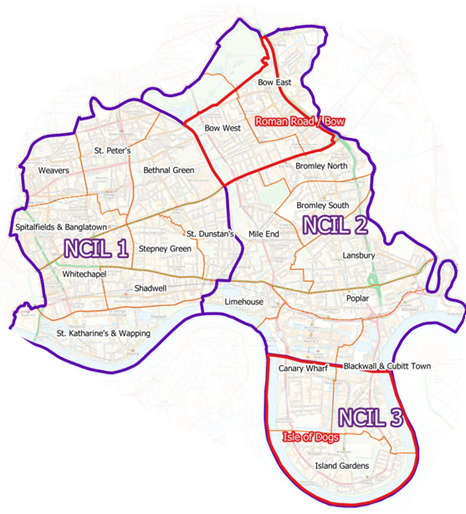
15-25% of CIL is allocated as Neighbourhood CIL (NCIL). This has to be spent in the NCIL area where the development occurred. It is 15% for most of the borough, but 25% for the two Neighbourhood Plan Areas – Roman road Bow, and the Isle of Dogs, the red areas in the map below. NCIL is one of the few mechanisms that can fund street market improvements, other public realm upgrades, community safety measures and cultural and heritage projects.
There is an existing mandatory exemption from CIL called ‘social housing relief’ for qualifying affordable housing. It applies nationally under the CIL Regulations, and Tower Hamlets implements it in line with these regulations.
One potential loss of CIL in Bow may be from the redevelopment of the large Council owned site behind the Roman Road Market, stretching from William Place to the Bow Idea Store.This site is in the Mayor’s Accelerated Housing Programme (MAHP). It’s not known yet if the new housing will be at least 20% affordable. Without CIL charges, Roman Road’s long‑awaited “high street uplift” becomes harder to deliver.
In Bow West, the approaching redevelopment of the west wing of the Chisenhale site for social housing means that mandatory exemption and the suspension of CIL will remove potential CIL funding to improve the rest of the building. Chisenhale Art Place are working hard to explore other funding sources, but support from the Council would help attract other funding.
Summary
The suspension of CIL for affordable housing sites will result in an immediate loss of predictable infrastructure funding, and infrastructure will continue to lag behind housing growth. Site-specific Section106 agreements cannot fully replace CIL, and there is a risk of widening inequalities between fast‑growing areas and established neighbourhoods like Bow.
There will be a loss of strategic infrastructure funding for the ex‑LLDC area (Fish Island, parts of Hackney Wick) which was expected to transition into Tower Hamlets’ CIL regime, providing public realm upgrades and community and cultural infrastructure. Suspending CIL removes a mechanism that was supposed to fund this transition.
Infrastructure planning is essential because new homes don’t exist in isolation. Without coordinated investment in transport, schools, health services, utilities, community facilities, green space, and digital networks, housing growth simply shifts pressure onto already stretched systems.